.webp)
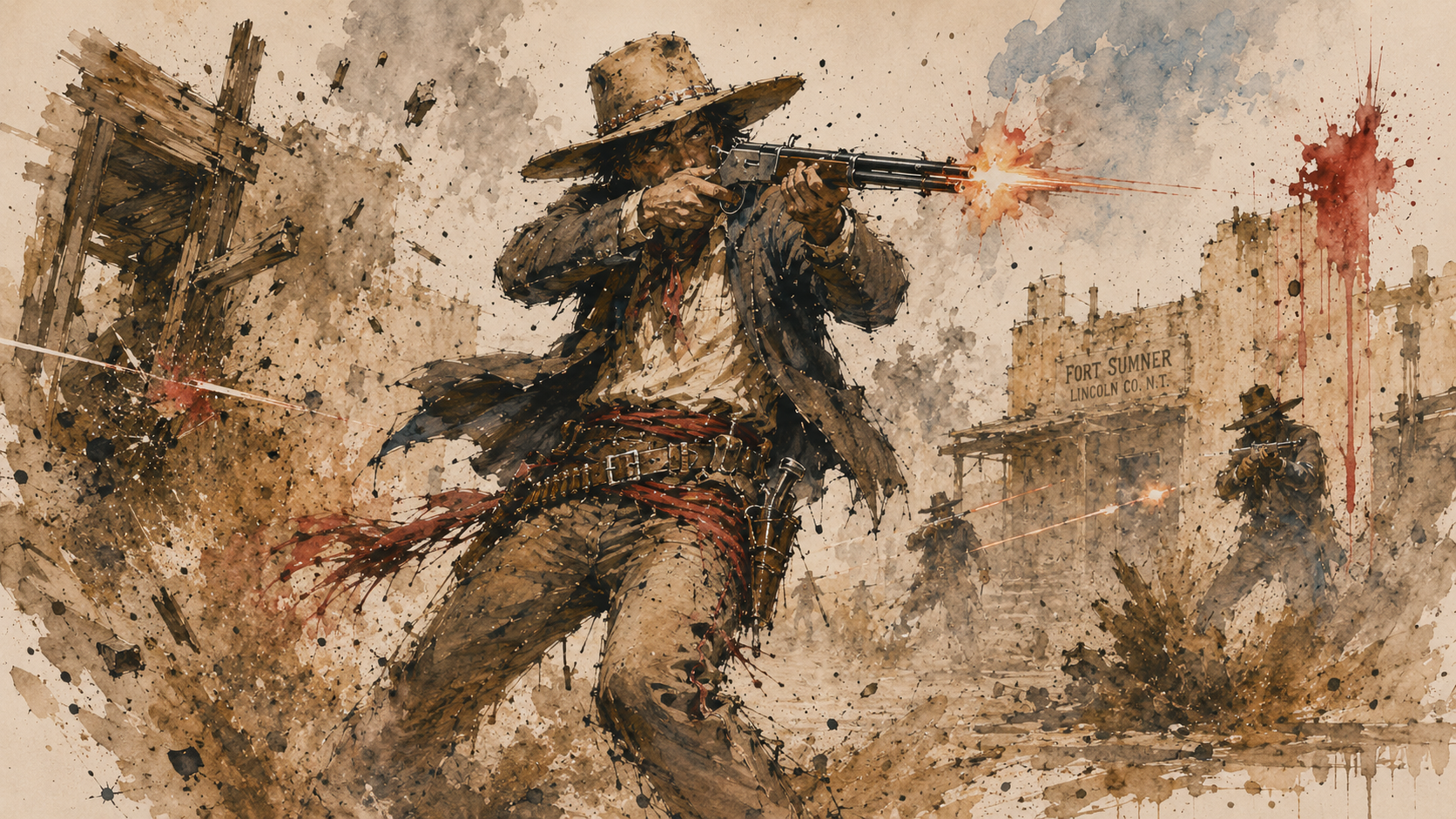
As I pack my gear and map out the itinerary for my fieldwork down in New Mexico this summer, tracing the exact ground where the Lincoln County War bled out, I have been thinking heavily about the mechanics of historical outlaws.
When you build an NPC for a historical TTRPG, you cannot rely on myth. You need a psychological blueprint. Billy the Kid is not merely a man in the archive; he is a man buried beneath a century of legend. Frontier America produced plenty of killers, but we remember Billy because he combined liveliness, charm, audacity, grievance, and violence into one compact, terrifyingly charismatic form.
To understand how to run a character like this at the table, we have to run him through a Big Five personality breakdown. What follows is an inferential reconstruction based on documented conduct, contemporary statements, and the violent realities of the New Mexico territory.
These scores are historically informed estimates on a 0–100 scale, designed to give Game Masters a functional psychological profile.
TraitEstimated ScoreReadingOpenness to Experience58Moderately highConscientiousness22LowExtraversion78HighAgreeableness34Low to mixedNeuroticism38Somewhat low
In shorthand: Billy the Kid was not a cold-blooded, calculating psychopath. He was a highly social, highly bold, weakly domesticated young man whose loyalty ran hot, whose fear ran low, and whose conscience was too tribal to be reliably moral. On a violent frontier, that combination becomes legendary.
Billy appears moderately high in openness, though not in the refined, scholarly sense. There is little evidence that he was contemplative. But there is massive evidence that he was adaptive, improvisational, and culturally fluid.
He moved seamlessly through shifting frontiers, alias to alias (born Henry McCarty, transitioned to William H. Bonney). He worked as a ranch hand, gambler, rustler, and regulator. He entered Anglo, Mexican, and mixed frontier settings with notable ease. In his last recorded moments in Pete Maxwell’s dark bedroom, his instincts defaulted to Spanish: “¿Quién es? ¿Quién es?” At the Table: He is clever in motion, not contemplative in structure. Play him as quick to adapt, hard to pin down, and capable of reading a room the second he walks into it.
Low conscientiousness is the defining feature of his profile. His life shows almost zero stable submission to duty, norms, or institutional order.
Look at the assassination of Sheriff William Brady in April 1878. Billy and his Regulators didn't challenge the Sheriff to a high-noon duel; they hid behind an adobe wall on the main street of Lincoln and ambushed him in the back. During the chaotic firefight, Billy broke cover and sprinted into the street to retrieve a rifle from Brady's corpse, taking a bullet to the thigh for his trouble. It was a lawless, impulsive, highly tactical strike. It is survival competence, not conscientiousness.
At the Table: Billy is not lazy chaos; he is selective discipline. He can be precise and patient when immediate danger or revenge requires it, but he is fundamentally allergic to routine and lawful order.
This is the strongest signal. Billy was socially forward, difficult to intimidate, and capable of retaining performative ease even under deadly pressure.
Nowhere is this clearer than his legendary escape from the Lincoln County Courthouse in 1881. Scheduled to hang, Billy managed to slip his cuffs, ambush Deputy James Bell on the stairs, and secure a 10-gauge double-barrel shotgun belonging to the other deputy, Bob Olinger. When Olinger heard the gunfire and ran across the street, Billy didn't just shoot him from the shadows. He leaned out the second-story window, looked down at his captor, and allegedly called out, "Hello, Bob," before giving him both barrels.
That is peak, dark extraversion. It is performative theatricality under extreme, lethal duress.
At the Table: Play him as verbally quick, easily amused, and astonishingly un-panicked. He is not a marble stoic. He is lively in the most dangerous sense of the word.
Agreeableness is the most mixed trait here. Billy had no generalized politeness, but he was highly tribal.
His first kill happened when he was just a teenager in Arizona. A local blacksmith named Francis "Windy" Cahill bullied the skinny kid, slapping him and throwing him to the dirt. Billy didn't submit; he pulled a revolver and shot Cahill in the gut. He possessed a hair-trigger opposition to humiliation. When his employer, John Tunstall, was murdered in "cold blood," Billy entered a retaliatory moral universe that fueled the entire Lincoln County War.
At the Table: He possesses a narrow-band agreeableness. He is fiercely loyal to his intimate circle, surprisingly personable face-to-face, but turns instantly lethal the second he judges someone false or threatening.
Billy was remarkably low in fearfulness and withdrawal. His emotional baseline was surprisingly steady in the face of catastrophic violence.
During the climax of the Lincoln County War—the Five-Day Battle—Billy and his faction were trapped inside the burning McSween house. Surrounded by heavily armed enemies and the U.S. Cavalry, with the roof literally collapsing in flames, Billy didn't panic. He orchestrated the breakout. He deliberately drew the enemy fire, allowing others to run, and then sprinted through the crossfire into the night, escaping against impossible odds.
He was not anxious; he was combustible.
At the Table: Billy does not brood like a gothic villain. He should be played as remarkably unafraid—until the moment something hits the nerve of loyalty or humiliation, at which point action comes fast, and it comes hard.
If you want Billy the Kid to feel authentic in your campaign, the key is not constant menace. The key is dangerous liveliness.
He should seem younger than his body count. Play him with an easy smile, a quick answer, and very little visible fear. Let him bond fast with people he likes, and make sure that betrayal registers not as a disappointment, but as a fatal moral rupture. Preserve the historical paradox: the air of a little boy joined to an iron firmness of purpose. That is the engine of a legend.
If you want to run encounters with this level of psychological depth and lethal historical realism, you need a system built for the trenches. Stop pulling your punches and step into the gritty world of PsychScape Historical.
You can secure the core rules directly on the Man of Ages website, or pick up your physical copy by searching PsychScape on Amazon.
— Racon Gunner