.webp)
I was down in the weeds recently with a writer friend of mine—a serious creative—discussing the current state of Tabletop RPGs. His frustration? The medium has become obsessed with Plot at the expense of Character.
We’ll debrief on that specific friction another time, but the conversation triggered a distinct realization for me. When I look back at the most visceral, memorable campaigns I’ve ever survived, there was one common variable:
The players weren't afraid to bleed.
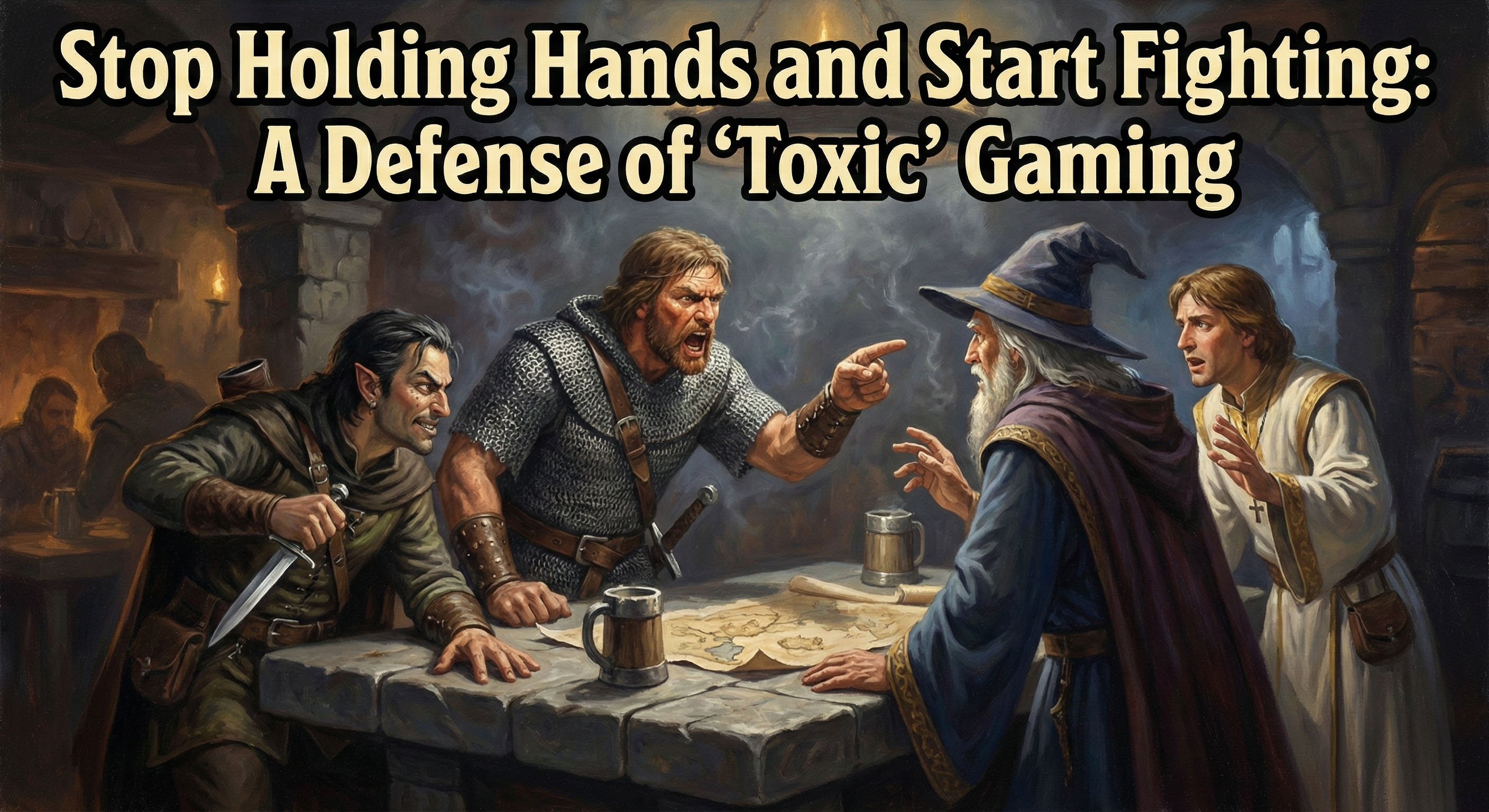
Let me clarify. I’m not talking about hit points. I’m talking about ego, agenda, and friction. In the best games, the characters drove the story not because they held hands, but because they were at each other’s throats.
Rewind to the late 80s. The golden age of AD&D. My gaming group didn't treat a campaign like a team-building exercise at a corporate retreat; we treated it like a theatre of war.
I remember a campaign where the party effectively split into factions—myself and two others in a standoff against the rest of the table. We spent an entire arc maneuvering against one another, political and physical warfare spilling out across the table. In another game, we were constantly at odds, nearly killing each other on a bi-weekly basis.
Later, when I was gaming with a crew in the Army, the stakes were even simpler: Competence was the currency.
If you built a weak character, or if you couldn't pull your weight tactically, the party didn’t "support" you. They took you out. Or, at the very least, they sidelined you until you shaped up. It was brutal, it was chaotic, and it was undeniably dynamic.
The friction forced us to be better. It bred competition.
I recall one campaign where I purposely rolled a Paladin four levels lower than the rest of the party. Why? To prove a point. I wanted to show them that even with a handicap, I was the superior tactician. I didn't need the stats; I had the drive.
Back then, we didn't leave our baggage at the door. If there was beef between friends, it leaked into the game. We hashed it out with dice and dialogue, much like the guys back in high school settling scores in the parking lot between periods. It was raw, but it was real.
Fast forward to today. The "Let's All Get Along" crowd has moved in and softened the edges.
Modern tables often feel sanitized. Everything is "fair." Everyone is on the "same team." Inter-party conflict is viewed as a failure of cooperation rather than an engine for drama. Sure, the tension is still there—human nature doesn't change—but now it’s buried under the surface, passive-aggressive and unspoken.
It’s boring.
Conflict drives narrative. If everyone agrees, there is no scene. The antagonists should be the goal, sure, but the friction between the protagonists is what makes the victory earn its keep.
So, this is my salute to the "toxic" parties out there. To the backstabbers, the rivals, and the players hacking their way through a dungeon while keeping one eye on the rogue next to them.
You’re not breaking the game. You’re the only ones actually playing it.