.webp)
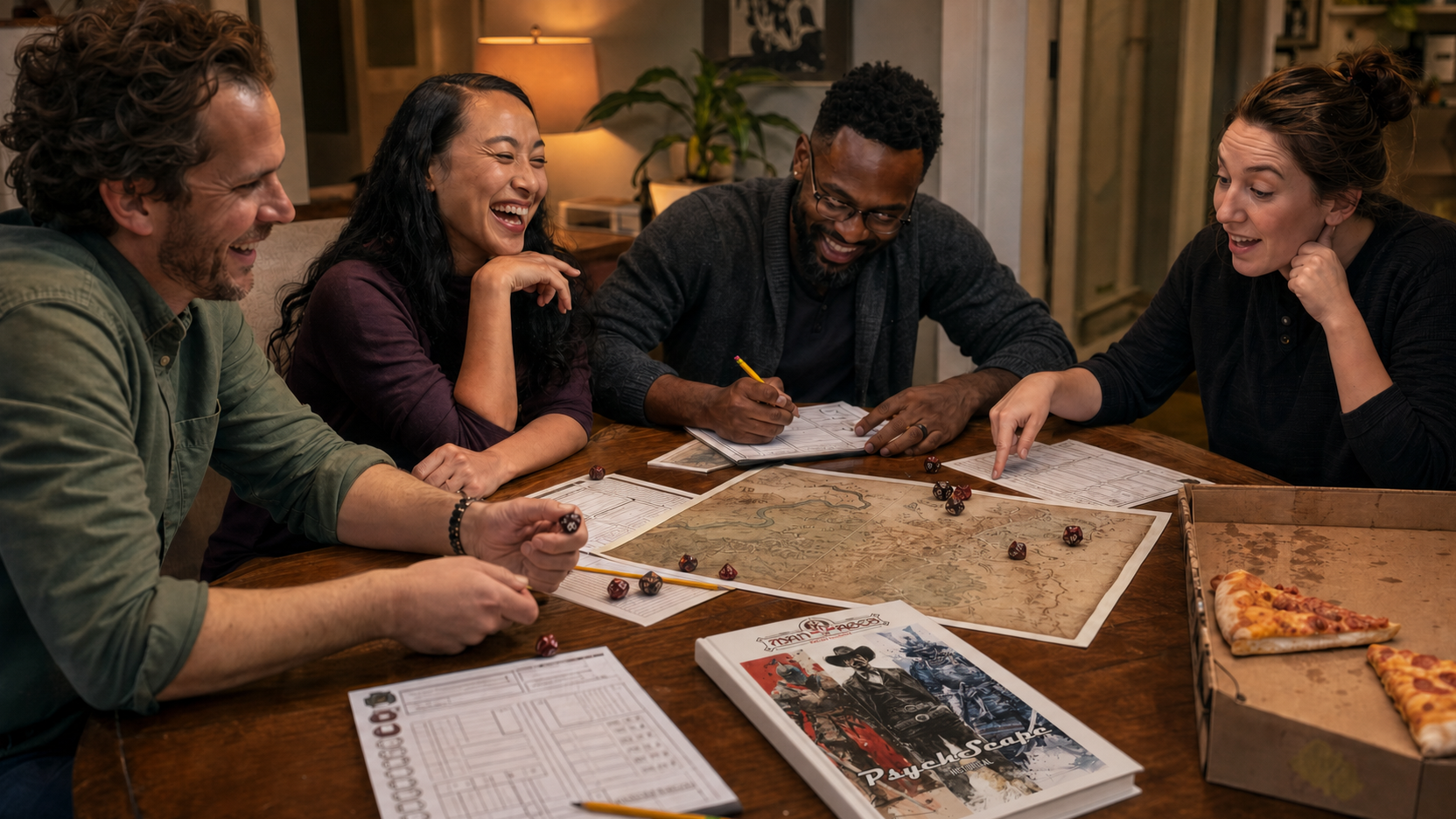
The pizza order became our clock.
At one end of the table sat a stack of blank character sheets. At the other sat the dice: a few ten-sided dice and percentile dice, waiting for someone to make the first move. The food was on its way. Nobody had created a character. Nobody had spent the afternoon studying build guides, comparing feat trees, or calculating whether a choice made now would become a mistake ten sessions later.
So we gave ourselves a challenge: could we build a complete group of PsychScape Historical characters before the doorbell rang?
Not placeholders. Not generic fighters with names penciled in at the last second. Full characters—people with distinct personalities, a Path through life, useful abilities, relevant skills, a personal strength, a troublesome shadow, money, gear, and a reason to step into history.
We could. More importantly, the characters did not feel rushed.
That is the trick PsychScape pulls off. Character creation moves quickly because each answer naturally produces the next question. Who are you? What Path fits that personality? What can you do? What tension from your past follows you into the adventure?
The system does not ask you to assemble a person from disconnected mechanical parts. It starts with a human being and lets the numbers grow outward from there.
Fast character creation does not have to mean shallow character creation. In PsychScape, the fastest choices are often the ones that create the most story.
Starting a new tabletop role-playing game can feel like preparing for a trip you have not decided to take.
Before the first scene begins, players may need to learn a world, compare character classes, browse long equipment lists, choose from dozens of special options, understand how those options interact, and coordinate choices with everyone else at the table.
For experienced players, that kind of system mastery can be fun. For a new player who simply wants to join the adventure, it can feel like being asked to pass an exam before being allowed to play.
PsychScape Historical approaches the problem from the opposite direction. It asks questions that people already understand.
Are you curious about the unknown or grounded in familiar traditions? Are you disciplined or spontaneous? Do you draw energy from a crowd or prefer to observe from the edge of it? Are you cooperative or fiercely independent? Do you remain steady under pressure, or do you feel danger and emotion with unusual intensity?
You do not need to know game jargon to answer those questions. You only need an idea of a person—and if you do not have one yet, the dice can discover that person for you.
PsychScape begins with the Big Five Personality Traits: Openness, Conscientiousness, Extraversion, Agreeableness, and Neuroticism.
These are not decorative notes tucked into a forgotten corner of the character sheet. They shape roleplay, suggest a Path, influence ability scores, and provide the raw material for a character’s background and development.
The Red Shield Edition presents two direct ways to generate them. A player can use the results of a comprehensive Big Five personality test for a nuanced profile, or roll a d100 once for each trait.
Five percentile rolls and the psychological outline of a new character is already on the page. The rules even allow players to switch results with one another if that produces a more interesting group.
There is no correct set of scores. High is not automatically good, and low is not automatically bad.
A character with high Openness may be inventive, curious, and eager to explore, yet too ready to dismiss tradition. A character with low Openness may be dependable and practical, yet slow to accept a new idea.
High Extraversion can create a natural storyteller who sometimes overshadows others. Low Extraversion can create a quiet observer whose best insights remain unspoken.
That balance matters. A trait does not hand you a virtue or a flaw. It hands you a tension, and tension is playable.
Within a few minutes, one player might be looking at a highly conscientious, low-agreeableness character: dependable, dutiful, and not especially interested in trusting the rest of the party.
Another might discover a highly open, highly extraverted character who cannot resist a mystery and cannot keep quiet about it.
Neither player had to write a page of backstory to find a voice. The voice was already beginning to emerge from five numbers.
Once the traits are visible, PsychScape helps the player choose a Path. The core Paths are Soldier, Healer, Scout, Blacksmith, Diplomat, Artisan, Scholar, Mystic, and Merchant.
The word “Path” is important. It is more than a job title. It describes the route a character has chosen through life and the kinds of challenges that have shaped them.
A Soldier brings combat training, leadership, and physical conditioning. A Scout leans toward navigation, stealth, and wilderness survival. A Diplomat relies on negotiation, etiquette, and language. A Scholar pursues knowledge and research. An Artisan creates. A Healer restores. A Merchant bargains. A Mystic follows spiritual insight. A Blacksmith turns strength and craft into something the group can use.
The Big Five Path Alignment Chart makes the choice quick. Players compare their high and low traits with the Paths linked to those results, count the matches, and see which options rise to the top.
That alignment is guidance, not a command. The rules explicitly leave the final decision with the player: the best Path is one that fits the personality and still sounds exciting to play.
This is where the group around the table usually begins talking in character without noticing it.
“The chart says Healer, but I think she learned medicine because she hates feeling helpless.”
“Mine keeps matching Scout. Maybe he is the only person who knows the mountain pass.”
“I have Soldier and Diplomat coming up. What if he is an officer who would rather end a fight with a treaty?”
Those are not optimization questions. They are story questions, and each one gives the Legend Master something useful before the adventure has even begun.
With personality and Path established, it is time to find out what the character can do. PsychScape uses seven abilities:
The basic generation formula is easy to remember: start at 35, roll 2d10, and add the result. Do that seven times.
Players can roll and assign their results in any order, so there is a small but meaningful decision about where the strongest numbers belong.
The Big Five profile then reaches into the mechanics. Qualifying high traits connect to particular abilities in the rules: Openness to Intelligence, Conscientiousness to Endurance, Extraversion to Personality, and Agreeableness to Instinct.
High Neuroticism affects Agility, representing the way emotional intensity and threat awareness can complicate clear action under pressure.
Spiritual Strength also offers a faith-focused questionnaire or a d100 alternative for tables that want that approach.
The result is a character whose ability scores do not feel detached from their personality. The outgoing diplomat is more than a label; Extraversion can support Personality. The disciplined survivor’s Conscientiousness can reinforce Endurance.
Psychology is not just flavor text in PsychScape. It has consequences.
Better still, the math stays light. There are no nested formulas to solve and no chain of prerequisites to audit. Roll, add, apply the relevant personality guidance, and move on.
Abilities describe a character’s underlying capacity. Skills describe training and experience. PsychScape keeps that distinction clear by dividing skills into broad Mainskills and focused Subskills.
Marksmanship might be a Mainskill; Rifle is a Subskill. Survival might be broad knowledge; Foraging, Hunting, or Shelter Building shows where that knowledge is concentrated. Medical covers a field; Surgery identifies a specialty.
A Mainskill is generated with the familiar 35 + 2d10 formula. A Subskill uses 10 + 1d10.
Choose skills that fit the Path, the historical setting, and the upcoming adventure, and the character quickly develops a practical identity.
A Scout in a wilderness campaign needs a different emphasis from a Diplomat entering a Byzantine court, even if both characters are observant and intelligent.
The core resolution system is just as direct: roll percentile dice and try to get equal to or under the relevant percentage.
For combat skills such as Marksmanship or Brawl & Blade, the “To Hit” number averages the Mainskill, the relevant Subskill, and the governing ability. Rolls of 01–05 are critical successes; rolls of 95–100 are critical failures.
That means a new player can understand the essential rhythm before the first scene:
The finer details can arrive when they matter. The first roll does not have to wait until everyone has memorized the entire book.
“Write a backstory” sounds simple until a blank page is staring back. PsychScape avoids that dead end by turning the personality scores into a prompt.
First, identify the character’s highest trait as a strength and the lowest as a weakness. Then use the background chart to choose an element, its shadow, and a challenge.
A highly conscientious character might be “Bound by Oath”: commitment gives the character direction, but the weight of that commitment may also suppress personal freedom.
A character with low Agreeableness might be a “Lone Wolf”: independence is valuable, but distrust keeps potential allies at a distance.
Put those two ideas together and the past begins to write itself:
She swore to return a fallen officer’s seal to his family, no matter how far the war carried her. She travels alone because the last companion she trusted sold their route to the enemy. Her challenge is not simply to finish the journey. It is to accept that she may need the other characters to survive it.
That is enough background to start playing. It explains a conviction, a source of conflict, and a direction for growth.
Names, family connections, keepsakes, and historical details can be added now or discovered later with the Legend Master. The rulebook encourages backgrounds to evolve as the campaign changes the character.
This is another reason creation is fast: PsychScape does not demand that you know everything about a person before you portray them. It gives you a strong first truth and leaves room for the table to reveal the rest.
The last steps are concrete.
Vitality Points equal Endurance multiplied by two.
Starting wealth is generated by rolling 2d10, multiplying by 100, and applying the Wealth Modifier tied to Conscientiousness.
“Gold” is a flexible term in the rules: the actual currency can become dollars, yen, silver, credit, or whatever belongs in the chosen era.
Then the player purchases equipment appropriate to the setting and the character’s Path.
A frontier Scout, a Roman Soldier, and a Renaissance Artisan will not reach for the same tools, but the decision is grounded in an identity the player already understands.
You are no longer browsing gear in a vacuum. You are asking what this specific person would carry into this specific moment in history.
Name the character. Record the Path, Big Five scores, abilities, skills, Vitality, wealth, and equipment.
The sheet is ready.
Our table did not use a stopwatch for an official speed record, and PsychScape does not need one. But the flow was easy to see:
By the time the food arrived, we did not have four piles of statistics.
We had a disciplined officer carrying an oath he had begun to resent, a curious Scout whose independence bordered on hostility, a calm Healer who struggled to show what she felt, and a loud Merchant who could charm a room but rarely let anyone else finish a story.
Everyone knew how their character might enter a scene. Everyone had a useful role. Everyone had at least one reason to clash with the world—and perhaps with one another.
That is a full character.
Quick creation would not matter if the characters ran out of room after one session. PsychScape is designed for them to change.
The Big Five traits create tensions that can evolve through play. Background challenges invite personal arcs. Skills can improve.
The TEN advancement system allows the Legend Master to award a block of ten percentage points to a single Skill, Subskill, Ability, or Big Five trait, turning growth into a visible moment in the character’s story.
A character may become more capable, or may even change the personality pattern that once held them back.
The game’s Theater of the Mind focus also helps a session begin without a miniature for every figure or a prepared map for every location.
The Legend Master establishes the historical moment, describes the pressure, and asks the most important question in role-playing: what do you do?
Because the character was built from personality outward, the player already has an answer.
The Soldier acts from duty. The Scholar cannot leave the mystery alone. The Lone Wolf refuses help until the situation makes that refusal costly. The charismatic Merchant steps forward to bargain.
Mechanics, history, and psychology meet in a choice, and that choice moves the story.
The next time someone says they would love to play a historical role-playing game but do not have time to learn one, order dinner and place a character sheet in front of them.
Pick an era. Roll five personality traits. Follow them toward a Path. Generate seven abilities. Choose the training that belongs to that life. Turn the highest and lowest traits into a strength and a shadow. Calculate the last few numbers, take the gear your character would never leave behind, and give that character a name.
When the doorbell rings, open the box.
Then open history.
Build your first PsychScape Historical character, gather your group, and blaze your own trail through the ages.