.webp)
A great tabletop role-playing game (TTRPG) setting is the lifeblood of a memorable encounter. I’m not talking about world-building from 30,000 feet, your grand empires and sweeping continents. I’m talking about the lowest tactical level: the exact, visceral space where your characters are standing when the steel is drawn.
All great stories rely on a classic narrative structure, Plot, Character, Setting, Conflict, Antagonist, Climax, and Resolution—unfolding in roughly that sequence. But setting does more than just give your characters a place to stand.
When Alfred Hitchcock discussed his masterpiece Psycho, he made it explicit that the story had to start in a highly specific place at a highly specific time to ground the plot. The opening shot literally stamps the screen with: Phoenix, Arizona. Friday, December the Eleventh. Two Forty-Three P.M. It was vital that it was a precise afternoon in a cheap hotel room, because the couple was in love, trapped in a dead-end affair, and the ticking clock of the workday drove Marion to steal the cash.
That is the power of setting as circumstance. But there is another kind of setting: the physical, interactive location.
The tavern, the weather on a muddy road, or the suffocating humidity of a deep forest, these elements matter. (I’ll dive into the tactical power of weather in a future dispatch). It is crucial that the space your characters occupy has a singular, specific hook. Something that instantly burns it into their memory.
Maybe the locals are a bit off, unsettlingly cheerful or completely hostile. Maybe there is a bizarre piece of architecture dominating the town square. These are great atmospheric touches, but if you want to run a truly masterful game, you need to go one step further: You must make the environment impact the play of the encounter.
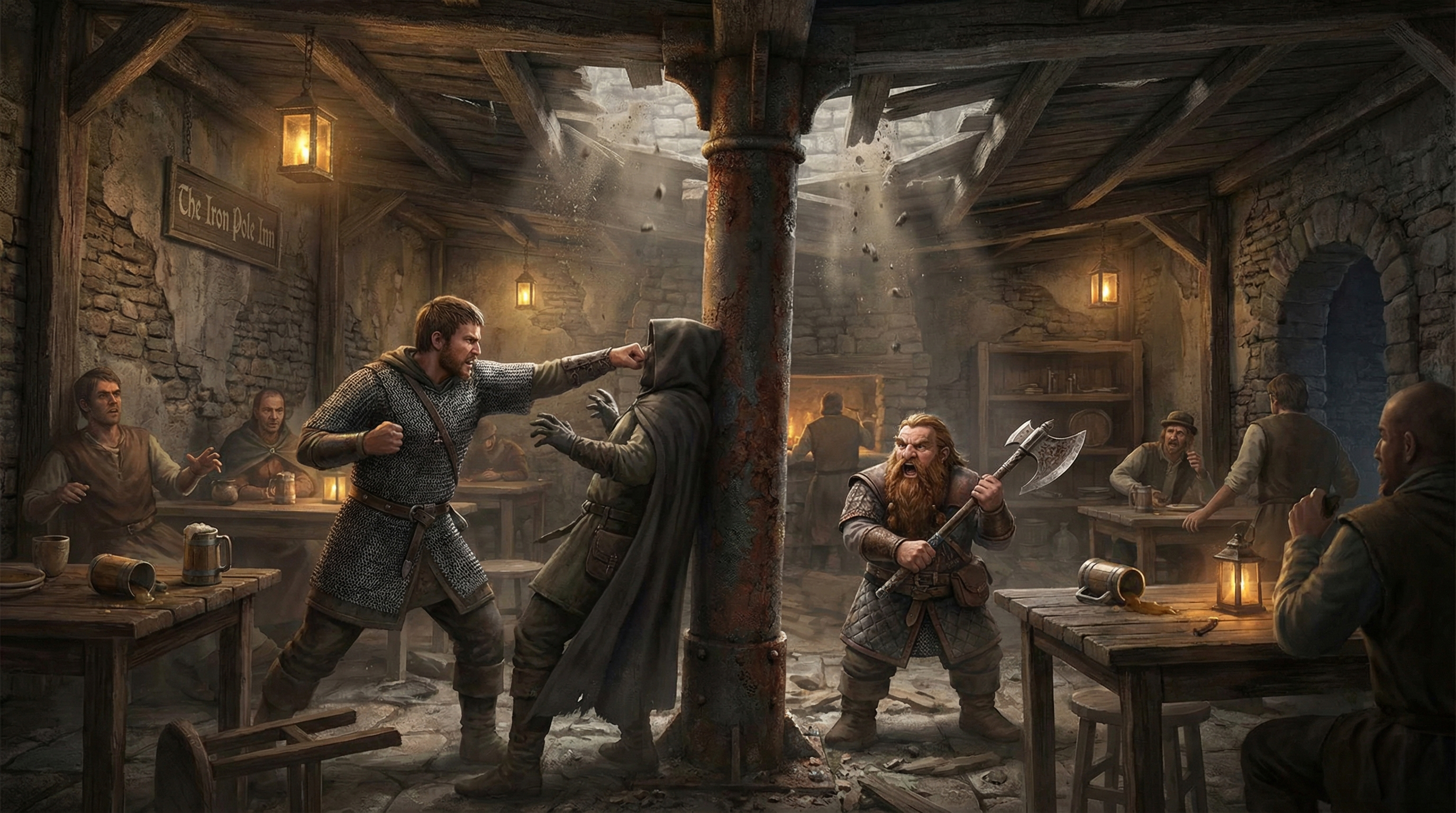
My personal favorite micro-setting for a tense encounter is a little dive I call "The Iron Pole Inn."
It’s an absolute ruin. The roof is sagging, the structure is slowly collapsing, and the ceilings are so claustrophobically low that only a dwarf can stand up straight without getting a crick in their neck. But it’s the only inn for miles, so travelers have no choice but to push through the doors. The owner, driven by stubborn sentimentality, outright refuses to fix the place.
Right in the middle of the room, near the bar, sits a single, load-bearing iron pole. It is the only thing keeping the roof from crashing down onto the taps.
And this is where the fun begins.
Inevitably, a brawl breaks out, a chaotic dance goes wrong, or some other physical exertion kicks off. During the chaos, a player character is going to roll a miss—or worse, a critical failure. When they do, someone gets shoved into the iron pole.
It groans. It shifts. Dust cascades from the splintering ceiling.
In the heat of a fight, they might barely notice the first bump. But as the encounter grinds on, the close quarters guarantee that every wild swing or failed block risks slamming into that pillar. Sometimes a heavy hit knocks it dangerously askew; another impact might temporarily knock it back into place. As the GM, you hold the dial on the suspense.
This mechanic injects a profound layer of conflict into an otherwise standard encounter. The threat of being crushed elevates the scene, making it infinitely more engaging.
You can deploy this exact same philosophy across your campaigns:
The more the characters and their enemies move around, the higher the chance the environment falls apart, compounding their grief. If the structure fails, everyone in the blast radius is eating damage and taking penalties.
To turn the screws, I frequently demand Agility or Dexterity checks for every maneuver made on unstable ground, just to maintain footing or escape the collapsing zone. This added layer of complexity forces players to think tactically, stay light on their feet, and transforms a standard stat-block fight into a truly unique, cinematic survival scenario.
Your next great campaign needs a setting that fights back. If you are looking to run games with this level of gritty, tactical realism and deep historical immersion, step into the trenches with my game, PsychScape Historical.
You can find the core rules right here on the Man of Ages website, or pick up your physical copy by searching PsychScape on Amazon. Equip yourself, and happy gaming.