.webp)
First, I want to address the heat on the last post.
The comments section was a warzone. I respect that. Whether you agreed that modern tables have become too soft or you came in defending the "everyone is friends" style—you engaged. That’s the point.
But amidst the shrapnel, I noticed a lot of people confusing "conflict" with "abuse." So, let’s cut through the fog of war and clarify the tactical reality of storytelling.
I am not walking back my statement. In fact, I’m doubling down.
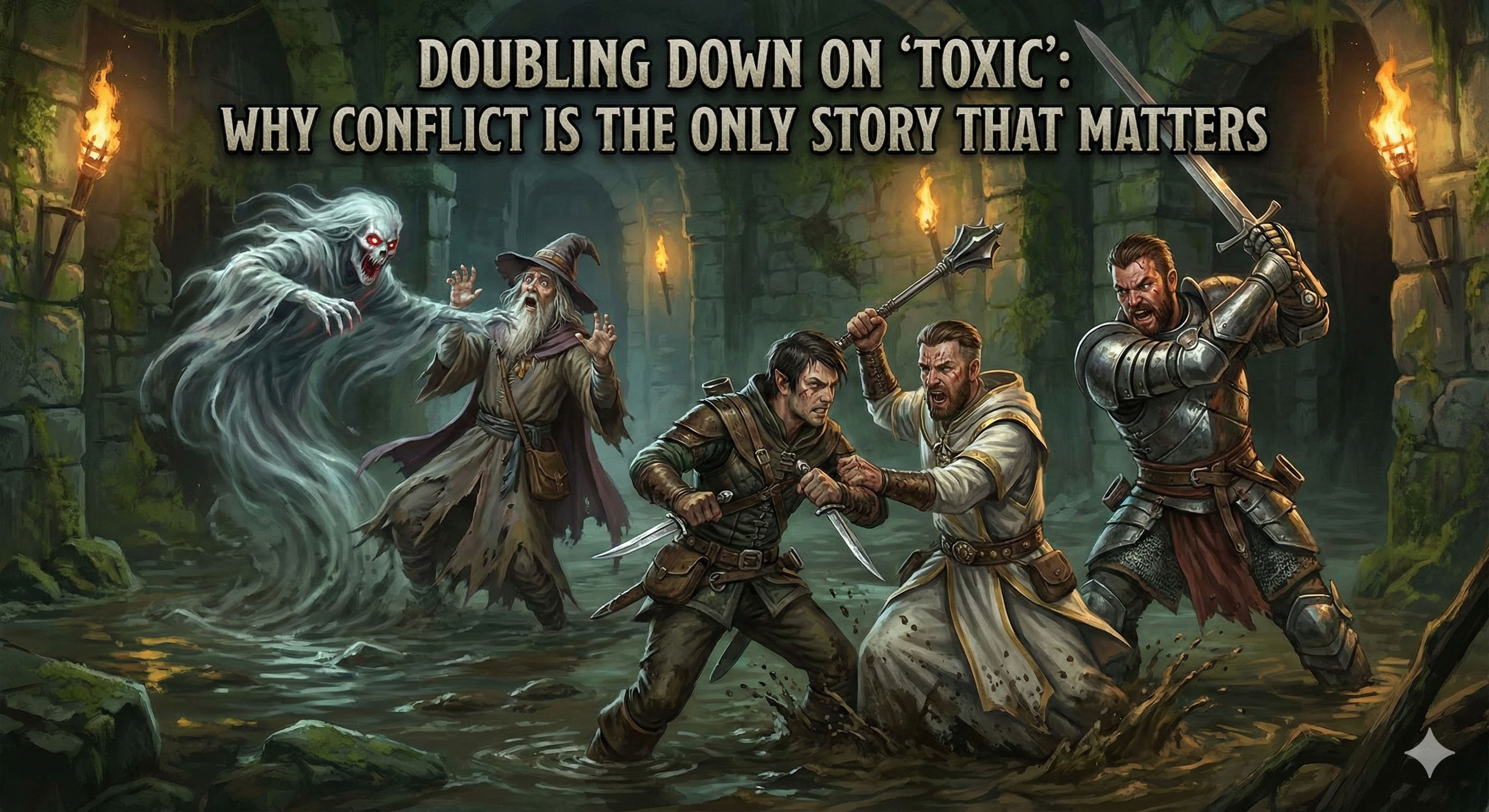
Conflict is the engine. Without friction, there is no forward momentum. If your party gets along perfectly, agrees on every plan, and executes without internal drama, you aren't playing a Role-Playing Game. You’re playing a spreadsheet.
To understand why, we need to look at the masters of the craft.
Recent cinema hits and timeless classics all rely on the same mechanic. Look at Jaws.
People think it’s a movie about a shark. It’s not. It’s a movie about three men trapped on a boat who fundamentally do not understand each other.
If Quint (the chaotic, working-class veteran) and Hooper (the rich, educated scientist) were best friends when the Orca left the harbor, Jaws would be a terrible film. It is a masterpiece because of the inter-party conflict.
Quint hates Hooper’s gear. Hooper hates Quint’s arrogance. Brody is caught in the middle. The tension inside the cabin is just as dangerous as the teeth outside the hull. That friction makes the "USS Indianapolis" monologue earn its silence. If they were polite to each other, that scene doesn't land.
The Lesson: Your party needs a Quint and a Hooper. The external threat (the monster) is just the excuse to put them in a room together.
Look at the recent hit The Bear. That kitchen is a dungeon crawl.
Carmy and Richie are ostensibly on the same "team"—they want the restaurant to succeed. But they are constantly at each other’s throats. They scream, they undermine each other, they clash over philosophy, hierarchy, and respect.
If they politely discussed the menu and high-fived after every service, the show would be unwatchable. The stress is the story. The conflict proves they care.
And then there’s my all-time favorite, Breaking Bad.
If you want to talk about "toxic" party dynamics, look at Walter White and Jesse Pinkman. They are the definition of a dysfunctional adventuring party.
Consider the moment Walt watches Jane die. He could save her. He chooses not to. It is a moment of pure, cold-blooded Player-vs-Player betrayal. It creates a secret, a wedge, and a ticking time bomb that drives the narrative for seasons.
Was it "nice"? No. Was it "cooperative"? Absolutely not. But it was the moment Walter White truly became Heisenberg.
When your Player Characters are at odds, the Game Master’s job gets easier. You don't have to force the plot; the players drive it with their own friction.
You need to stop viewing disagreement as a problem to be solved and start viewing it as a resource to be exploited.
So take a cue from the greatest stories ever told. Build the friction into the character sheets.
If you want to understand the mechanics of this—how to actually engineer these moments without just being a jerk—I broke down the tactical categories of conflict in a previous briefing.
Read the Tactical Breakdown Here: Know Your Enemy: The 5 Types of Conflict
Make your players uncomfortable. Make them argue. Make them care.